
Food, Recipes and Travel Adventure from the Emerald lsle



- Online Store
- Our Favorite Irish Food Products
- Irish Beverages
- Irish Coffee and Tea
- Irish Jams
- Irish Bread and Scones
- Irish Cheese
- Irish Appetizers
- Irish Deli
- Irish Mustards
- Irish Relishes & Sauces
- Irish Cookies and Cakes
- Irish Candy
- Chocolate Lovers Page
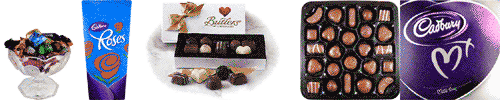
- Butlers Irish Chocolates
- Irish Chocolate
- Irish Food Gifts - Baskets, Boxes & Boards
- Irish Food Recipes
- Irish Entree Recipes
- Irish Broccoli & Cheese Pie
- Tyna's Favorite Pizza Crust
- Tyna's Tangy Tomato & Cheese Pizza
- Baked Ham with Pineapple & Brown Sugar Glaze
- Bacon & Cabbage
- Grilled Bacon (Rashers) Lettuce & Tomato Sandwiches
- Popover Pudding with Irish Bacon
- Grilled Irish Sausages (Bangers)
- Irish Apple Maple Pork Chops
- Spareribs with Mango Chutney Marinade
- Chicken Breasts with Apple-Cherry Chutney
- Herbed Mustard Chicken
- Irish Roast Turkey with Chestnut and Prune Stuffing
- Irish Turkey Pie
- Tyna's Famous Roast Turkey
- Tyna's Sweet Loaf
- Beef and Guinness Pie
- Beef Pot Roast with Beans in Red Wine
- Family Secret Steak Marinade
- Irish Corned Beef Dinner
- Roast Prime Rib with Spinach Porcini Stuffing
- Grilled Salmon
- Seared Salmon with Raison and Caper Butter
- Irish Casserole Recipes
- Irish Side Dish Recipes
- Boxtie
- Tyna's Potato Pancakes
- Homemade French Fries
- Irish Accordian Potatoes
- Tyna's Grilled Potato Halves
- Mashed Potatoes and Parsley Sauce
- Mustard Scalloped Potatoes
- Roasted Mustard Potatoes
- Potato & Leek Bake
- Irish Sweet Potato Bake
- Maple Candied Sweet Potatoes
- Roast Sweet Potatoes
- Glazed Carrots
- Orange Glazed Carrots
- Sauteed Zucchini & Summer Squash
- Tangy Shredded Beets
- Tyna's Homemade Baked Beans
- Irish Dressed Cabbage
- Irish Pub Salad
- Tyna's Cool Carrot Salad
- Tyna's Homemade Coleslaw
- Tyna's Irish Egg & Potato Salad
- Tyna's Macaroni Salad With Crabmeat
- Tyna's Famous Turkey Stuffing
- Irish Appetizer Recipes
- Deviled Eggs
- Sweet & Spicy Snack Mix
- Irish Chedder Triangles
- Irish Cheese Bites with Chutney
- Parsley Cheese Ball
- Autumn Veggie Platter
- Crispy Irish Parsnips
- Irish Leek & Swiss Tarts
- Guinness Batter Onion Rings
- Wild Rice & Barley Stuffed Mushrooms
- Irish Bangers in a Blanket
- Irish Sausage Kebabs
- Irish Shillelagh Sticks
- Salami Rolls
- Irish Chicken Wings with Guinness
- Teriyaki Chicken Wings
- Prawn Bundles with Herb Mayonnaise
- Irish Drink Recipes
- Irish Soup & Stew Recipes
- Autumn Harvest Bisque
- Chunky Irish Potato and Leek Soup
- Potato and Leek Soup
- Fresh Vegetable Soup
- Irish Carrot Soup
- Parmesan Corn Chowder
- Quick Borsch
- Tyna's Summer Beet Soup
- Chunky Bacon and Cabbage Soup
- Dublin Coddle
- Tyna's Chunky Pea Soup with Ham
- Irish Fisherman's Chowder
- Guinness Chicken Stew
- Tyna's Beef Barley Stew
- Tyna's Calico Chili
- Irish Bread & Scone Recipes
- Irish Pie Recipes
- Irish Cookie and Bar Recipes
- Celtic Spiral Cookies
- Pinwheels and Checkboards
- Easter Sugar Cookies
- Halloween Sugar Cookies
- Shamrock Sugar Cookies
- Cherry Cordial Cookies
- Chocolate Carmel Cookies
- Chocolate Pots with Crunchy Irish Oatmeal Cookies
- Oat-Nut-Raisin Chippers
- Oatmeal Maple Drop Cookies
- Gingerbread Teddy Bears
- Irish Tea Cakes
- Mint Chocolate Clouds
- Peanut Butter Mice
- Springerle Cookies
- Irish Flag Bars
- Fruit & Oat Bars
- Irish Chocolate Mint Squares
- Irish Cream Brownies
- Chocolate Walnut Brownies
- Irish Candy Recipes
- Chunky Fruit & Nut Fudge
- Irish Cream Coffee Fudge
- Irish Fifteens Bonbons
- Peanut Butter Bonbons
- Maple Caramels
- Chocolate Irish Cream Truffles
- Double Dark Chocolate Truffles
- Molded Candy For Halloween
- Maple Popcorn Balls
- Cinnamon Popcorn Balls
- Mom's Summer Cracker Jack
- Maple Caramel Apples
- Maple Candied Apples
- Irish Cakes and Frosting Recipes
- Irish Wedding Cake
- Traditional Irish Christmas Cake
- Irish Rasberry Vanilla Cake
- Apple & Blackberry Cake with Irish Whiskey Custard
- Porter Cake
- Irish Whiskey Cake
- Irish Vanilla Christmas Sponge Cake
- Irish Carrot-Raisin Cake with Irish Cream Frosting
- Irish Lemon Carrot Cake for Mother's Day
- Tyna's Snow-Capped Lemon Fairy Cakes
- Irish Apple Cake
- Chocolate Irish Cream Truffle Cake
- Irish Cream Chocolate Mousse Cake
- Guinness Stout Chocolate Layer Cake
- Chocolate Mayonnaise Cake
- Bunny Cake
- Tyna's Two Christmas Cakes in One
- No-Bake Layered Ice Cream Cake
- Best Buttercream Frosting
- Mrs. Milman's Dark Choclate Frosting
- Bailey's Irish Cream Cheesecake
- Irish Whiskey Eggnog Cheesecake
- Quick Cherry & Cream Cheese Dessert Cake
- Deluxe Holiday Cheesecake
- Tyna's Lemon Topped Mini Cheesecakes
- Irish Dessert Recipes
- Irish Cream Pudding Parfaits with Oatmeal-Walnut Crunch
- Irish Mince Tartlets
- Irish Applesauce Spice Cake Fancies
- Christmas Bread Pudding
- Mothers' Christmas Plum Pudding
- Pumpkin & Cream Cheese Roll
- Creamy Irish Rice Pudding
- Maple Apple Dessert
- Chocolate Box with Berries & Cream
- Grandmother's Torte
- Tyna's Irish Cream Coffee Torte
- Pavlova
- Guinness and Irish Whiskey Recipes
- Irish Entree Recipes
- Irish Food History
- Boxtie or Boxty?
- History of Bailey's Irish Cream
- History of Corned Beef and Cabbage
- History of Irish Soda Bread
- Irish-Cookery
- Irish Food Newsletter
- 2011 Newsletters
- 2010 Newsletters
- 2009 Newsletters
- 2008 Newsletters
- 2007 Newsletters
- 2006 Newsletters
- Online Store


- Ireland
- Irish Sites to See
- Irish Cities
- Ireland's Rivers
- Flights to Ireland
- Ireland Accommodations
- Irish Castle Accommodations
- Tyna's Ireland Travel Tips
- Bord Failte - Bureau of Ireland Travel
- Ireland Travel Stories
- The Holidays in Ireland 2009
- Summer 2007
- March 2007
- November 2006
- Arriving in Ireland
- The Graveyard Search
- The Thomas Casey Family
- The Bohans of Rynn
- O'Brien's Tavern
- A Night With Old Friends
- Mary Burke, Willia & The Boys
- Arnold Fitzpatrick
- Lough Rynn Castle
- Shopping in Connacht
- The Willett
- Where is John Reynolds?
- The Dance
- Departure: Glebe Street / Arrival: Kiltale House
- Adventures In County Meath
- Visiting With The Lydons
- March 2005
- Summer 1998
- April 1998
- Tell us YOUR Ireland Travel Story

- Irish Traditions
- Irish Celebrations
- St. Valentine's Day in Ireland
- St. Patrick's Day
- Irish Easter Traditions
- Irish Daffodil Day
- Irish National Famine Memorial Day
- The Irish and All Hallows Eve
- Irish Christmas
- Ireland's Rose of Tralee International Festival
- Celtic Holidays in Ireland
- Ancient Irish Wedding Customs
- Ireland and the Word 'Holiday'
- How to Throw an Irish Party
- Irish Poetry
- Irish Treasures
- The Irish Book of Kells
- The Shrine pf St. Patrick's Bell
- The Irish Shillelagh
- Ancient Irish Weaponry
- Ancient Irish Relics
- History of the Irish Cross
- Irish History of the Tara Brooch
- History of the Irish Claddagh
- History of the Irish Knit Sweater
- The History of Irish Wade Pottery
- The History of Irish Kilt
- The History of Belleek Irish Porcelain
- The History of the Irish Linen
- The History of the Irish Lace
- Irish Waterford Crystal
- Irish Music
- Irish Organizations
- Native Irish Dog Breeds

- Irish History
- Northern Ireland National Anthems
- The Irish National Anthem
- Irish Immigrants in America
- History of Irish Guinness Stout
- The History of Irish Whiskey
- The Irish English Language
- The Irish Gaels
- Ancient Irish Writing - Ogham
- History of the Irish Flag: The Republic of Ireland
- The Free University of Ireland or Saor-Ollscoil Na hÉireann
- History of Irish Dance
- Irish Saints
- The Irish in Australia
- The Titanic and Ireland
- Custom of the Irish Matchmaker
- History of the Irish Defence Forces
- Irish Legends and Myths
- The Legend of The Irish Banshee
- The High Kings of Ireland
- Celtic Queen Medb of Connaught
- The Myth About Irish Knit Sweaters
- The Irish Legend of Deirdre of the Sorrows
- Ghost watch in Ireland: The Helena Blunden Story
- The Irish Legend of the Fairy Race
- The Fairies' Revenge
- The Irish Phouka
- The Irish Legend of Finn MacCoul
- Finn MacCoul and The Salmon of Knowledge
- Finn MacCoul and The Isle of Man
- Finn MacCoul and The Giants Causeway
- How Finn MacCoul and His Men Were Bewitched
- Research Irish Heritage
- Irish History


The History of Irish Whiskey
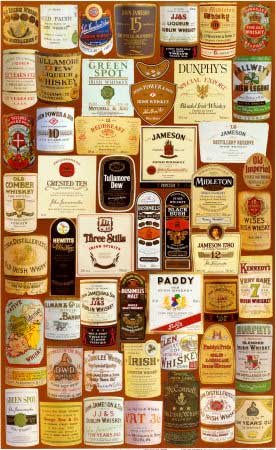 |
The history of Irish Whiskey, 'Uisce Beatha', meaning 'water of life' in Gaelic, began over 800 years ago. In the 16th century, Queen Elizabeth I was apparently quite fond of it but missed the opportunity to raise extra revenue by taxing the distillers. However, the opportunity was not lost forever because, on Christmas day in 1661, the government introduced a tax of four pence on each and every gallon of distilled whiskey.
By 1785 the tax on whiskey climbed to one shilling and tupence and, by 1815, it had risen to six shillings which proved to be too expensive for many. The result of this high tax drove many to produce their whiskey illegally and, by the end of the 18th century, there were some 2000 illicit stills in operation in Ireland. Many of these produced 'poteen' which is the equivalent to American 'moonshine' or 'white lightning'. Some of these distillers decided to become legal and tried to raise money to set up larger distilleries. Of those, the most successful, by far, were the three big Dublin distillers - John Power, John Jameson, and George Roe.
John Power & Son Whiskey:
James Power was originally a coaching innkeeper on Thomas Street in Dublin. It is probably unlikely that he could have known how successful his 'new' business would become when, in 1791, he founded a small distillery by converting his inn into a distillery. By 1800, James was joined in the business by his son John. Originally known as James Power & Son, by 1809 the business name was changed to John Power and Son, with James remaining in charge. The business continued to grow successfully and, in 1823, John Power boasted of a 500 gallon still with an annual output of 33,000 gallons of whiskey per year. This was the start of something big and, within another ten years, the company's yearly output had increased to over 300,000 gallons.
This success had benefits for a family that within one generation had risen from innkeepers to members of Dublin's high society. John Power was knighted and became High Sheriff of Dublin. Because of his celebrity he was chosen to lay the foundation stone for the O'Connell Monument.
In 1871, the distillery was rebuilt in classic Victorian style occupying almost seven acres. It was one of Dublin's most impressive sights and it employed approximately 300 people. John Power and Son continued in their success and became one of the largest Irish Whiskey distillers. Powers was the first Whiskey company to sell their product in miniature bottles called 'Baby Powers'. The importance of their influence in government facilitated changes to the distilling law in order to produce this innovation.The last member of the Board with the Power name was Sir Thomas Talbot Power. After his death in 1936, ownership remained in the family through his sisters. Powers remained a leading player in the industry until 1966 when they merged with the only two remaining distillers in the Irish republic, Cork Distillers Company and their long time rival, John Jameson & Son.
George Roe Whiskey:
George Roe and Company began in 1757 when Peter Roe bought a small distillery on Thomas Street in Dublin. This Thomas Street distillery was powered by the largest windmill at that time in all of Europe. Today, the windmill's tower still stands against the Dublin skyline. It is blue capped with copper sheeting and a weather vane in the likeness of St. Patrick. It is known as St. Patrick's Tower, and it is located on what is now Guinness property. In fact, two years after Peter Roe established the Thomas Street Distillery, Arthur Guinness set up his famous St. James' Gate Brewery across the street. Despite the fact that they were close neighbors, and that they shared the complementary businesses of producing alcoholic beverages, they did not share professional admiration for one another. Over the years, generations of the Guinness family considered their stout to be the 'nurse of the people', while they considered whiskey to be the 'curse of the people'. In private, it is suspected that generations of the two families would have enjoyed both Guinness Stout and Roe Whiskey.
In 1766, Richard Roe took over the Thomas Street Distillery and, in 1784, Nicholas Roe founded a separate distillery on Pimlico Street, a few blocks away. In 1832, his son, George Roe took over both the Thomas Street and Pimlico distilleries, consolidating and expanding them into quite a large complex. The resulting organization became known as George Roe & Company or Geo. Roe & Co., Distillers. George Roe's sons, Henry and George Jr., took over the company in 1862 and, by 1887, it had been built into the largest distillery in Europe. At that time the Thomas Street Distillery covered seventeen acres and Geo. Roe & Co., Distillers were producing two million gallons of whiskey annually. Roe whiskey had a large and important export to the United States, Canada, and Australia.
During the heyday of Geo. Roe & Co., Henry Roe donated a substantial portion of the Roe distillery wealth to the restoration of Christ Church Cathedral in Dublin. The restoration included the building of the attached Synod Hall, which now houses the tourist attraction, Dublina. Between 1871 and 1878, he donated the astronomical sum of 220,000 to 250,000 pounds, which is equivalent in today's market to approximately $25,000,000. Following its restoration, a new thoroughfare was cut in the vicinity of Christ Church and, although it was named Lord Edmund Street, a local witticism at the time was 'Roe Row'.
In 1889, Geo. Roe & Co., Distillers joined William Jameson & Co. and the Dublin Whiskey Distillery (better known as D.W.D.) to form a trading unit called the Dublin Distilling Company, Ltd. Each distillery continued to market its own whiskey under its own name and mark.
The late 19th and early 20th centuries was a very difficult period for the whiskey industry in Ireland, and the Roe distillery was no exception. Competition from Scottish blended whiskies, prohibition in the United States, and social and economic instability in Ireland caused many distilleries to fail. By 1926, Geo. Roe & Co., Distillers and its two partners, had ceased producing whiskey, although they still possessed large quantities of unsold stock in storage. In the mid 1940's, the Limited Company dissolved, and Geo. Roe & Co., Distillers went out of business. Finally, in 1949, Guinness took over the site of the old Roe Thomas Street Distillery.
During the early decades of the Thomas Street Distillery in Dublin, another line of the same Roe family established a distillery in New Ross, Co. Wexford - the Roe and Fletcher Distillery. Over the years, the Roes became the sole proprietors and their operation came to include a brewery as well. In 1832, the Roes sold the complex to an established brewing family, the Cherrys. Today Cherrys' Breweries Ltd. is part of The Waterford Brewery, and under the Guinness Ireland Group.
Jameson Whiskey:
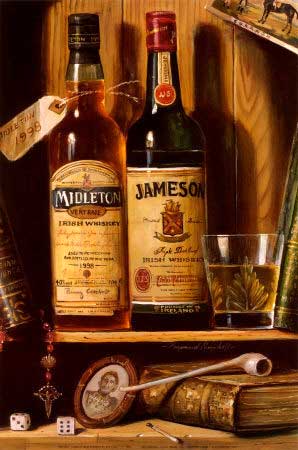
John Jameson's Dublin Distillery was founded in 1780 and laid down a tradition for quality and success. His family motto and guiding philosophy was 'Sine Metu', meaning 'Without Fear', which appears today on every bottle of Jameson Irish Whiskey.
 |
Jameson set new standards in whiskey distilling by investing in the latest manufacturing processes. When he discovered that certain strains of barley made a superior whiskey, he persuaded local farmers to grow them by providing seed grain every spring. He also insisted that only the finest casks available were used for maturation.
By 1820, John Jameson & Son was the second largest distilling company in Ireland. News about the high quality of the Jameson whiskies traveled far and wide, and demand was growing abroad as well as in Ireland. The combination of fine whiskey ingredients and superior distilling processes was making quite a name for Jameson Whiskey worldwide.
In 1858, a blight destroyed France's vineyards and consequently supplies of brandy dried up. Traditional brandy drinkers switched to Irish whiskey and Jameson sales soared. By 1890, Ireland had about 90% of the global whiskey export market, and Jameson's distillery was making 10% of Ireland's annual whiskey output. After more than 100 years of growth and success, Jameson Whiskey was about to be dealt two cruel blows.
Before prohibition in 1919, Jameson was a best selling whiskey in America. After prohibition, exports of Jameson to the USA ground to a halt. Up until 1922, Jameson was the most popular whiskey in the British Empire but, after Irish Independence, tariff barriers priced it out of the market. Without overseas demand, all 400 Irish whiskey brands fell into decline.
By 1966, only three whiskey distilling companies were left in the Republic of Ireland and John Jameson & Sons was one of them. In a bold bid to keep the spirit of Irish whiskey alive, the four joined forces and formed Irish Distillers Group. In 1975, Irish Distillers opened a new state of the art whiskey distillery in Midleton. Co. Cork. Jameson Whiskey was then distilled outside of Dublin for the first time in 200 years.
Today, over 220 years after John Jameson opened his doors, Jameson Irish Whiskey is the fastest growing international whiskey in the world. To this day, John Jameson's passion lives on in the exceptionally smooth Irish whiskey that still bears his name.
Bushmills Whiskey:
Bushmills claim to be the 'Worlds Oldest Whiskey Distillery' is based on the undisputed fact that a seven year license to distill, dating from April 20th 1608, is attributed to the distillery. Located near the town of Bushmills, Co. Antrim, Northern Ireland, the distillery has had its ups and downs, which includes being destroyed by fire in 1885.
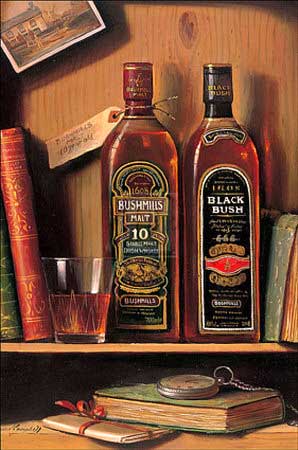 |
Bushmills produces many fine whiskeys but the most well known is Bushmills Irish Whiskey. However, they also produce the classic Bushmills Black Bush. In 1996, they also started to supply Bushmills 16 year-old rare single Irish Malt Whiskey. It is now currently part of the Irish Distillers Group, having been bought in 1972.
Together, Power, Roe and Jameson formed the Irish Distillers Group. In 1989, the Pernod Ricard empire successfully bid against Gilbey's and Guinness-Cantrell-Cochran to become the new owners of the Irish Distillers Group, which also includes Bushmills Distillery. Due to Pernod Ricards' success, the last four members of the old distilling families resigned.

Irish Coffee & Tea
Irish Chocolate

Become a fan of LittleShamrocks.com
on FaceBook


An Lar Community Television Ireland

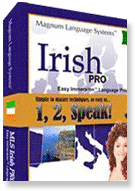
Irish Immersion Pro
A Simple Way to Master the Irish Language
Slash Your Energy Bill
Wind & Solar Power
How-to Guides

Wind & Solar Power
How-to Guides
WATERFORD
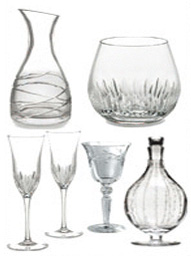

Terry's Favorite
Ireland Book!
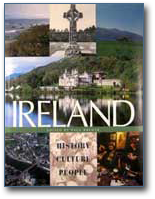
Ireland: History,
Culture, People
Ireland Book!
Ireland: History,
Culture, People
Buy Maple Syrup
& Maple Candy
Disclaimer: LittleShamrocks.com is an affiliate website that receives commissions from sales of the products listed. We have purchased and sampled many, but not all, of the products on these pages.

© Copyright LittleShamrocks.com. All Rights Reserved.