
Food, Recipes and Travel Adventure from the Emerald lsle



- Online Store
- Our Favorite Irish Food Products
- Irish Beverages
- Irish Coffee and Tea
- Irish Jams
- Irish Bread and Scones
- Irish Cheese
- Irish Appetizers
- Irish Deli
- Irish Mustards
- Irish Relishes & Sauces
- Irish Cookies and Cakes
- Irish Candy
- Chocolate Lovers Page
- Butlers Irish Chocolates
- Irish Chocolate
- Irish Food Gifts - Baskets, Boxes & Boards
- Irish Food Recipes
- Irish Entree Recipes
- Irish Broccoli & Cheese Pie
- Tyna's Favorite Pizza Crust
- Tyna's Tangy Tomato & Cheese Pizza
- Baked Ham with Pineapple & Brown Sugar Glaze
- Bacon & Cabbage
- Grilled Bacon (Rashers) Lettuce & Tomato Sandwiches
- Popover Pudding with Irish Bacon
- Grilled Irish Sausages (Bangers)
- Irish Apple Maple Pork Chops
- Spareribs with Mango Chutney Marinade
- Chicken Breasts with Apple-Cherry Chutney
- Herbed Mustard Chicken
- Irish Roast Turkey with Chestnut and Prune Stuffing
- Irish Turkey Pie
- Tyna's Famous Roast Turkey
- Tyna's Sweet Loaf
- Beef and Guinness Pie
- Beef Pot Roast with Beans in Red Wine
- Family Secret Steak Marinade
- Irish Corned Beef Dinner
- Roast Prime Rib with Spinach Porcini Stuffing
- Grilled Salmon
- Seared Salmon with Raison and Caper Butter
- Irish Casserole Recipes
- Irish Side Dish Recipes
- Boxtie
- Tyna's Potato Pancakes
- Homemade French Fries
- Irish Accordian Potatoes
- Tyna's Grilled Potato Halves
- Mashed Potatoes and Parsley Sauce
- Mustard Scalloped Potatoes
- Roasted Mustard Potatoes
- Potato & Leek Bake
- Irish Sweet Potato Bake
- Maple Candied Sweet Potatoes
- Roast Sweet Potatoes
- Glazed Carrots
- Orange Glazed Carrots
- Sauteed Zucchini & Summer Squash
- Tangy Shredded Beets
- Tyna's Homemade Baked Beans
- Irish Dressed Cabbage
- Irish Pub Salad
- Tyna's Cool Carrot Salad
- Tyna's Homemade Coleslaw
- Tyna's Irish Egg & Potato Salad
- Tyna's Macaroni Salad With Crabmeat
- Tyna's Famous Turkey Stuffing
- Irish Appetizer Recipes
- Deviled Eggs
- Sweet & Spicy Snack Mix
- Irish Chedder Triangles
- Irish Cheese Bites with Chutney
- Parsley Cheese Ball
- Autumn Veggie Platter
- Crispy Irish Parsnips
- Irish Leek & Swiss Tarts
- Guinness Batter Onion Rings
- Wild Rice & Barley Stuffed Mushrooms
- Irish Bangers in a Blanket
- Irish Sausage Kebabs
- Irish Shillelagh Sticks
- Salami Rolls
- Irish Chicken Wings with Guinness
- Teriyaki Chicken Wings
- Prawn Bundles with Herb Mayonnaise
- Irish Drink Recipes
- Irish Soup & Stew Recipes
- Autumn Harvest Bisque
- Chunky Irish Potato and Leek Soup
- Potato and Leek Soup
- Fresh Vegetable Soup
- Irish Carrot Soup
- Parmesan Corn Chowder
- Quick Borsch
- Tyna's Summer Beet Soup
- Chunky Bacon and Cabbage Soup
- Dublin Coddle
- Tyna's Chunky Pea Soup with Ham
- Irish Fisherman's Chowder
- Guinness Chicken Stew
- Tyna's Beef Barley Stew
- Tyna's Calico Chili
- Irish Bread & Scone Recipes
- Irish Pie Recipes
- Irish Cookie Recipes
- Celtic Spiral Cookies
- Pinwheels and Checkboards
- Easter Sugar Cookies
- Halloween Sugar Cookies
- Shamrock Sugar Cookies
- Cherry Cordial Cookies
- Chocolate Carmel Cookies
- Chocolate Pots with Crunchy Irish Oatmeal Cookies
- Oat-Nut-Raisin Chippers
- Oatmeal Maple Drop Cookies
- Gingerbread Teddy Bears
- Irish Tea Cakes
- Mint Chocolate Clouds
- Peanut Butter Mice
- Springerle Cookies
- Irish Dessert Bar Recipes
- Irish Candy Recipes
- Chunky Fruit & Nut Fudge
- Irish Cream Coffee Fudge
- Irish Fifteens Bonbons
- Peanut Butter Bonbons
- Maple Caramels
- Chocolate Irish Cream Truffles
- Double Dark Chocolate Truffles
- Molded Candy For Halloween
- Maple Popcorn Balls
- Cinnamon Popcorn Balls
- Mom's Summer Cracker Jack
- Maple Caramel Apples
- Maple Candied Apples
- Irish Cakes and Frosting Recipes
- Irish Wedding Cake
- Traditional Irish Christmas Cake
- Irish Rasberry Vanilla Cake
- Apple & Blackberry Cake with Irish Whiskey Custard
- Porter Cake
- Irish Whiskey Cake
- Irish Vanilla Christmas Sponge Cake
- Irish Carrot-Raisin Cake with Irish Cream Frosting
- Irish Lemon Carrot Cake for Mother's Day
- Tyna's Snow-Capped Lemon Fairy Cakes
- Irish Apple Cake
- Chocolate Irish Cream Truffle Cake
- Irish Cream Chocolate Mousse Cake
- Guinness Stout Chocolate Layer Cake
- Chocolate Mayonnaise Cake
- Bunny Cake
- Tyna's Two Christmas Cakes in One
- No-Bake Layered Ice Cream Cake
- Best Buttercream Frosting
- Mrs. Milman's Dark Choclate Frosting
- Bailey's Irish Cream Cheesecake
- Irish Whiskey Eggnog Cheesecake
- Quick Cherry & Cream Cheese Dessert Cake
- Deluxe Holiday Cheesecake
- Tyna's Lemon Topped Mini Cheesecakes
- Irish Dessert Recipes
- Irish Cream Pudding Parfaits with Oatmeal-Walnut Crunch
- Irish Mince Tartlets
- Irish Applesauce Spice Cake Fancies
- Christmas Bread Pudding
- Mothers' Christmas Plum Pudding
- Pumpkin & Cream Cheese Roll
- Creamy Irish Rice Pudding
- Maple Apple Dessert
- Chocolate Box with Berries & Cream
- Grandmother's Torte
- Tyna's Irish Cream Coffee Torte
- Pavlova
- Guinness and Irish Whiskey Recipes
- Irish Entree Recipes
- Irish Food History
- Boxtie or Boxty?
- History of Bailey's Irish Cream
- History of Corned Beef and Cabbage
- History of Irish Soda Bread
- Irish-Cookery
- Irish Food Newsletter
- 2011 Newsletters
- 2010 Newsletters
- 2009 Newsletters
- 2008 Newsletters
- 2007 Newsletters
- 2006 Newsletters
- Online Store

- Irish Crosses
- Irish Jewelry
- Irish Sweaters
- Irish Shillelaghs
- Irish Handkerchiefs
- Irish Communion Gifts
- Waterford Crystal Gifts

- Ireland
- Irish Sites to See
- Irish Cities
- Ireland's Rivers
- Flights to Ireland
- Ireland Accommodations
- Irish Castle Accommodations
- Tyna's Ireland Travel Tips
- Bord Failte - Bureau of Ireland Travel
- Ireland Travel Stories
- The Holidays in Ireland 2009
- Summer 2007
- March 2007
- November 2006
- Arriving in Ireland
- The Graveyard Search
- The Thomas Casey Family
- The Bohans of Rynn
- O'Brien's Tavern
- A Night With Old Friends
- Mary Burke, Willia & The Boys
- Arnold Fitzpatrick
- Lough Rynn Castle
- Shopping in Connacht
- The Willett
- Where is John Reynolds?
- The Dance
- Departure: Glebe Street / Arrival: Kiltale House
- Adventures In County Meath
- Visiting With The Lydons
- March 2005
- Summer 1998
- April 1998
- Tell us YOUR Ireland Travel Story

- Irish Traditions
- Irish Celebrations
- St. Valentine's Day in Ireland
- St. Patrick's Day
- Easter In Ireland
- Irish Daffodil Day
- Irish National Famine Memorial Day
- The Irish and All Hallows Eve
- Irish Christmas
- Ireland's Rose of Tralee International Festival
- Celtic Holidays in Ireland
- Ancient Irish Wedding Customs
- Ireland and the Word 'Holiday'
- How to Throw an Irish Party
- Irish Poetry
- Irish Treasures
- The Irish Book of Kells
- The Shrine pf St. Patrick's Bell
- The Irish Shillelagh
- Ancient Irish Weaponry
- Ancient Irish Relics
- History of the Irish Cross
- Irish History of the Tara Brooch
- History of the Irish Claddagh
- History of the Irish Knit Sweater
- The History of Irish Wade Pottery
- The History of Irish Kilt
- The History of Belleek Irish Porcelain
- The History of the Irish Linen
- The History of the Irish Lace
- Irish Waterford Crystal
- Irish Music
- Irish Organizations
- Native Irish Dog Breeds

- Irish History
- Northern Ireland National Anthems
- The Irish National Anthem
- Irish Immigrants in America
- History of Irish Guinness Stout
- The History of Irish Whiskey
- The Irish English Language
- The Irish Gaels
- Ancient Irish Writing - Ogham
- History of the Irish Flag: The Republic of Ireland
- The Free University of Ireland or Saor-Ollscoil Na hÉireann
- History of Irish Dance
- Irish Saints
- The Irish in Australia
- The Titanic and Ireland
- Custom of the Irish Matchmaker
- History of the Irish Defence Forces
- Irish Legends and Myths
- The Legend of The Irish Banshee
- The High Kings of Ireland
- Celtic Queen Medb of Connaught
- The Myth About Irish Knit Sweaters
- The Irish Legend of Deirdre of the Sorrows
- Ghost watch in Ireland: The Helena Blunden Story
- The Irish Legend of the Fairy Race
- The Fairies' Revenge
- The Irish Phouka
- The Irish Legend of Finn MacCoul
- Finn MacCoul and The Salmon of Knowledge
- Finn MacCoul and The Isle of Man
- Finn MacCoul and The Giants Causeway
- How Finn MacCoul and His Men Were Bewitched
- Research Irish Heritage
- Irish History


History of The Irish Kilt
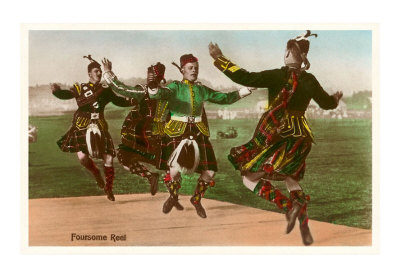 |
Four Highland Dancers in Kilts
|
Anachronism: An error in the chronological placement of persons, events, objects or customs.
The Irish kilt ... is this a traditional ancient garment? Is it a remnant of the early Celtic race? Was it only later brought into Scotland by migrating Gaels? Most of our assumptions are based on myth, legend and the anachronistic Hollywood film industry. They are infamous for using objects, customs and wardrobes that have no business being in some of the movies. For example, the costumer on the movie Braveheart didn't do much historical research by fitting Mel Gibson with a kilt. He was playing the role of a 13th century warrior, wearing a 17th century garment and painting a blue face from the 2nd century.
There is no evidence in early Irish records to support the theory that the kilt was invented in Ireland. Many stone carvings on crosses and monuments in Ireland, dating before the 11th century, claim that the figures are wearing kilts. This is inaccurate because what is actually pictured is called a leine, or Irish tunic. The leine may have a skirt reaching to the knee but it is simply the lower part of the tunic, not a separate garment as the kilt is. It is not related to the kilt in any way, nor can it be said to be an early one.
There is also some confusion about the garments worn by soldiers and knights. They were wearing quilted armor from the Middle Ages known as cotuns in Irish. They are long, heavy, quilted and padded tunics that serve as light armor. In ancient carvings, the quilting is depicted with vertical lines running down the tunic, which is often mistaken for pleating, and the knee length garments are often claimed to be kilts.
In the 16th century, again we find representations of Irish men that are supposed to be wearing kilts. There are depictions of many figures wearing garments with heavily pleated skirts. These are not modern kilts, but leines, which by this time had evolved into wrap around shirts with wide, hanging sleeves and elaborately pleated skirts.
Nowhere has good solid evidence been found to support the kilt being worn in Ireland. At the earliest, only since the middle of the 19th century, has it even been suggested that the kilt was worn in Ireland. Irish writers of the time never mention the wearing of the kilt at all.
Is the kilt a form of medieval dress? No. At renaissance fairs men may be seen in very modern kilts with what are sold as Jacobite shirts, but these people are simply believing what they have been taught by the poorly researched myths that pass for Scottish history. The earliest documentation for Scotland is from 1093. In the Magnus Berfaet saga, King Magnus goes to the western isles of Scotland and adopts the garments worn there, referred to as 'barelegged men'. Wishing to prove the early existence of a kilt, people usually cite this document but a kilt is never mentioned. Just because of the fact that these men went barelegged, the assumption was made that they must have been wearing a kilt. However, the clothing that is mentioned corresponds with the contemporary dress of the Irish Gaels of the time, which was the leine.
In the 16th century, we begin to see a type of kilt called a feilidh-mhor (Gaelic for great wrap), a breacan-feile (tartan wrap), or simply a belted plaid; all considered to be the same garment. A plaid or 'plaide' is a length of heavy woolen fabric worn over the body like a shawl. It does not refer to the modern American word plaid, except that they were often of a tartan pattern, which is synonymous for plaid in America. This garment would be gathered into folds and belted around the body. The first reference to anything that may be taken as a belted plaid is not until as late as 1578. The clothing was made for use but mainly suited for war, not ornamentation. These were long, flowing garments capable of being neatly gathered up into folds but in no way can this be claimed as a form of the kilt.
In the 16th century they wore plaids of many colors. They preferred dark brown or natural colors, used not only for warmth but for camouflage. Since it refers to plaids and seems to indicate a tartan pattern, it is assumed that it is a kilt or belted plaid. By the description, it is not an Irish mode of dress, but was that of the Scots.
The earliest picture of a belted plaid comes from after 1600, from circa 1610. It depicts a length of wool or a linen-wool blend, most often of tartan pattern of between four and five yards. However, since the material of the time was only about 25 inches wide, it would have to have been doubled in width to reach from the head to the knees. Most likely, eight or nine yards would have been obtained. This corresponds with the earliest surviving tailored kilts we have, which all contain about four yards of cloth.
There are no written instructions on how it was put on. According to depictions of the era, they began by laying the cloth out on the ground, then gathered the center part of the plaid into folds or pleats. The goal was to reduce the four or five yards of material to about one and one-half times the waist measurement. Precision was not needed when folding it. They lied down on the plaid parallel to the pleats, with the lower edge near the knees, then wrapped the two unpleated ends around the waist, overlapping them left over right. Using a sturdy leather belt, they ran it around the waist and fastened it tightly. Then they would stand up and arrange the remainder of material around the upper body, such as pulling around behind the back and tucking it into the belt at the base of the spine. There were most likely other personal preferences on how to wear the belted plaid.
The predecessor of the modern kilt was called the feilidh-beag (little wrap). The word in English is 'phillabeg' which was the natural evolution of the belted plaid, consisting of only the bottom or 'skirt'. The first instance of the pleats being sewn into place was in 1792, creating a true tailored kilt. This kilt is in possession of the Scottish Tartans Society and is currently on display at the Scottish Tartans Museum in Franklin, North Carolina.
The Tartan
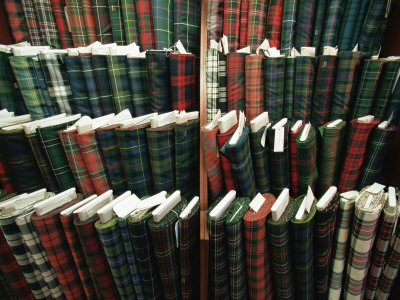 |
Tartan Cloth, Macnaughtons Emporium, Pitlochry, Scotland, United Kingdom
|
A discussion on the history of the kilt must contain the history of the tartan. Where did it come from and what does it mean? Tartan is derived from the French word 'tiretaine', meaning a linsey-woolsey fabric, but does not pertain to the pattern or design of it. Sometime in the 16th century, the word first appeared in Scotland and was probably adopted because the French and Scottish were linked by the blood lines of the dynasties. The Gaelic word for tartan is 'breacan'. The Scottish word 'plaide' refers to the large wrap garment worn from the late 16th century to the late 18th century. This is confusing according to what Americans know about kilts and tartans. The specific pattern of interlocking stripes has been adopted in America as plaid, meaning tartan. Previous to the 16th century, this wool-blend fabric would have been any color that could be obtained with the natural dyes of the location where it was made. Clans and families simply did not have any identifying tartans in this early period.
Starting here, the word tartan is meant as the fabric with interlocking stripes. The earliest evidence of tartan plaid in Scotland was called Falkirk Tartan, named for the town where it was discovered. It was a simple dark and light check, also known as 'shepherd's plaid', dating to 325 A.D., but it is not the earliest known tartan in history. Tartan patterned cloth could be found nearly anywhere a culture had the technology to weave. Archaeologists have found people wearing tartan patterned clothing that dates to over 5000 years ago. This is not proof that clan tartans are prehistoric but that the material was being produced by ancient weavers.
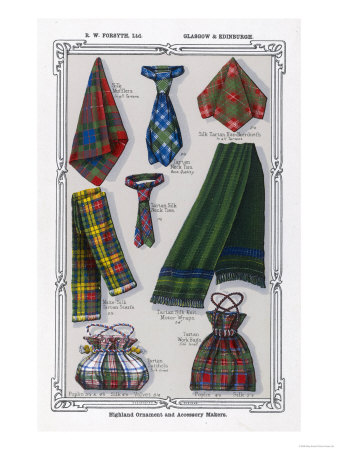 |
Tartan Accessories 1902
|
Tartan was originally worn in 16th century Scotland as fashionable attire. All tartan was hand woven and each weaver created unique and attractive designs based on the dyes available. Some colors may have been more common in one area than another but nothing approaching modern clan tartans would have existed. Tartan weavers were artisans who crafted a variety of tartan designs.
By the 18th century, tartan fashion had become outstanding. Surviving fabric from this period includes yellows, purples, golds, greens, oranges, reds, blues and any number of other bright colors, woven in even more intricate patterns. Later, after the massacre at Culloden, tartan dress, bagpipes and anything of Gaelic Scottishness was forbidden. This practice was also followed in Gaelic Ireland. It was not until after the clan system was broken, and this act was repealed 32 years later, that the idea of clan tartans really began to form.
The first standardized tartans were woven by William Wilson, owner of William Wilson & Sons woolen mill of Bannockburn. Wilson was the first commercial producer of tartan material. Using his new mechanical looms, he could repeat the same pattern of tartan over and over again without fail. The patterns were known by number but it was not long before names were attached. Wilson assigned them names of romantic localities or popular ruling families. The 19th century was a time of romance and tradition so it was a brilliant job of salesmanship on the part of Mr. Wilson. Sir Walter Scott added to Scotland's romantic appeal and soon tartan was the rage in England. Everyone of Scottish descent wanted to wear their own clan tartan. Queen Victoria loved all things Scottish and insisted that all Scotsmen wear their clan tartan while visiting her.
Even though this system of clan tartans was relatively new in the 19th century, the myth already existed that it was an ancient tradition. Soon, so-called 'experts' began to travel the country placing people into this clan or that, and telling them what their 'ancient and traditional' clan tartan was. Because of this practice, some people feel discouraged but it does not change the fact that today many Scottish clans, families, towns, businesses and districts are validly represented with a particular tartan. Tartan is as much a part of Scottish tradition as anything else but the historical garment known as the belted plaid predates the standardization of the clan tartan.
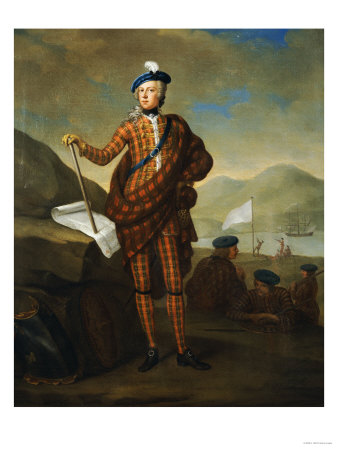 |
Harlequin Portrait of Prince Charles Edward Stewart (1720-1788), in Red Tartan Coat, Breeches
|

Irish Coffee & Tea
Irish Chocolate

Become a fan of LittleShamrocks.com


Disclaimer: LittleShamrocks.com is an affiliate website that receives commissions from sales of the products listed. We have purchased and sampled many, but not all, of the products on these pages.

© Copyright LittleShamrocks.com. All Rights Reserved.